Discover the Thermal Wonderland Beauty

Wai-O-Tapu Explorer by Kiwi Driver Tours
This is an independent visitor guide created by Kiwi Driver Tours & Transfers. We are not
the official Wai-O-Tapu Thermal Wonderland website. Attraction entry, opening hours and activity availability should be checked directly with the attraction before travel.


1 Mahunga Rua
The first example of collapsed craters where the acidic steam coming from underground has caused
ground to collapse Note, the rough sides and yellow-greenish colours of these twin craters where cooling volcanic vapours have coloured the walls.

2 Te Rua Uenuku
The brilliant colours you see around the walls of the creator are due to oxidation and reflect rainbow-like colours. The minerals produce the following colours
Brown/Red: Iron Oxide
Purple: Manganese Oxide
Yellow: Sulphur
Pink: Cinnabar (Mercury Sulphide) used in Chinese lacquer ware
White: Kaolin (also known as Chinese Clay)
The first people living in the area would gather the oxidized iron to mix with fish and whale oil to
create a paint like substance, red ochre, which was traditionally used to paint structures and marae.
3 Te Rua Whaitiri
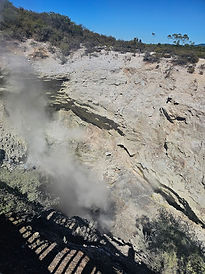
A collapsed crater formed in 1968, of which when it initially collapsed, sounded like rolling thunder.
The acoustics of this crater continue to reproduce the sound of thunder.
This crater is now four times its original size and it will continue to grow as the 98-degree water constantly gives
off acidic steam.

4 Ipu
These pools of mud contain unrefined crude oil, in the late 1800's and early 1900's the sludge on the top of these pots was skimmed off to burn in kerosene lanterns. Heated by thermal vents from below the surface, the temperature of the mud is about 50 degrees Celsius, ? Fahrenheit. The colour and the consistency of the mud is from a combination of small parts of graphite and crude oil.
These pools are rainwater fed and fluctuate throughout the year

5 Artist’s Palette
Overflowing water from the Champagne Pool brings with it minerals that have originated deep below the surface. As the waters cool, it evaporates, exposing minerals that provide the showcase of colours.
This area never looks the same two days in a row, changing depending on sunlight, water level and wind direction

6 Te Waiāriki o Mahuika
The hot spring of Mahuika is a sulphurous spring on the edge of the sinter terrace. From here, there is a great side view of the terraces and down the valley to Ohaaki geothermal power station in the distance. Geothermal Power contributes about 15% of the total electricity to New Zealand’s Power Grid.

7 Sinter Terraces
These sinter terraces are the largest In New Zealand. The water that flows over the terraces is from the Champagne Pool. As it flows over the terraces it evaporates and leaves behind geyserite. This process has been going on for over 700 years, and the Terraces cover an
area of approximately 1.5 hectares. These terraces are constantly growing both upwards and outwards.
In amongst the trees is an unmarked ancestral Urupa (burial ground) which makes this area sacred. It was reported in newspaper articles that the last burial in this area was in 1910. Wāhi Tapu was also known as a place where ancestral Māori would return children’s pito (umbilical cord) back to the land, amongst the trees.

9 Wāhi Tapu
In amongst the trees is an unmarked ancestral Urupa (burial ground) which makes this area sacred. It was reported in newspaper articles that the last burial in this area was in 1910. Wāhi Tapu was also known as a place where ancestral Māori would return children’s pito (umbilical cord) back to the land, amongst the trees.

9 Panoramic View
The Kaingaroa Forest meaning ‘a long way without food’, is the largest man-made forest in the Southern hemisphere. Lake Ngakoro is the green waters you see in the distance. You can reach it following the green pathway. From this point on a clear day you can also see the southern reaches of the Taupo Volcanic Zone and the highest mountain on the North Island, Mount Ruapehu.

10 Te Rere Ārai Mārena
These falls mark the end of the sinter terraces. Partially coloured by the overflow from Te Waiāriki O Mahuika (6). The green colour can be attributed to bacteria and archaea. From here, the water flows into a shallow creek towards Lake Ngakoro.

11 Alum cliffs (not accessible)
The cliffs have shallow horizontal ridges that have been eroded from hundreds of years of weathering. Opposite the cliffs you will see Papa Wera beside an acidic lake that is about 700 years old.

12 Papa Wera
Papa Wera is an eruption crater that has an unstable floor which is littered with bubbling hot springs and small vents releasing volcanic gasses. Papa Wera is home to the Poaka bird, also known as the Pied Stilt. These small black and white birds have long legs and feed on the insects in the area.

13 Te Puna Tio
Viewed from the timber boardwalk and located in unstable ground, this naturally sulphurous pool is in the shape of an oyster.
14 Rua Whānāriki
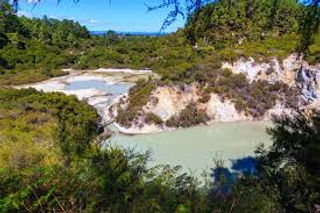
Viewed from the track, there are magnificent examples of sulphur crystals formed here as the hot hydrogen sulphite gas has cooled and crystallised in the sheltered area of the overhanging cliff.

15 Puna o Ngakoro
This waterfall flows over the rocks into the green waters of Lake Ngakoro. You can see the majority of the lake, which was likely formed from a hydrothermal eruption over 700 years ago. Warm water springs flow into this lake making it warm year-round and allowing for an algae bloom that gives it the green colour you see.

16 Native Bush Walk
The walk follows a ridge through a strand of giant Kānuka trees before dropping into the valley linking Echo Lake with Papa Wera. The high canopy of trees and spring waters which flow through the area provide an excellent habitat for native birds such as Bellbirds, Tui, Pīwakawaka and Tomtits.

17 Puke Whānāriki
Looking like large anthills, these are sulphur mounds that were formed under water before this area was drained for the building of a road in the 1950s

18 Te Waiāriki O Aporo
Chief Aporo was one of Wai-O-Tapu’s charismatic characters of the past. He was one of the first people to offer guided tours in the area as early as the late 1800s. He was renowned for enjoying a soak in this bath filled with water that ran off from the Champagne Pool.

19 Champagne Pool
The largest hot spring in New Zealand measuring 65m diameter and 62m deep, with a surface temperature of 74 degrees Celsius. The bubbles caused by carbon dioxide provide the Champagne like effect in the water. Formed an estimated 700 years ago by a hydrothermal eruption, some of the minerals contained in the water include gold, silver, mercury, sulphur, arsenic, thallium, and antimony

20 Rua Pūmahu
This crater has a bottom of boiling hot mud. In recent history, an earth archway that linked the sides together was destroyed by the acidic steam coming from the bottom of the crater. The sounds from this crater were recorded to create Foley. These were then featured in scenes of Mordor in the Lord of the Rings Trilogy.

21 Rua Ōwhanga
Starlings, swallows and mynas nest in holes on the walls of this collapsed crater. The heat from below rises up to help incubate the eggs and to keep the birds warm

22 Anga Whānāriki
Sulphur crystals have formed beautiful formations on the wall above the vents in this crater. To the extreme right there are some of the few chlorine pools in the area that may have been used by the local people to cook in.

23 Roto Kārikitea
This crater is filled with excess water from the Champagne Pool. The amazing colour is the result from a deposit of minerals being suspended in the water and refracting the sunlight. This pool will vary in colours, being brighter on sunny days and duller on cloudy days. The PH of this pool is 2, making it extremely acidic. The temperature is 14 degrees Celsius.
